Coming Back to Life in Nature: Arachne on an Ecoretreat

Coming Back to Life in Nature: Arachne on an Ecoretreat

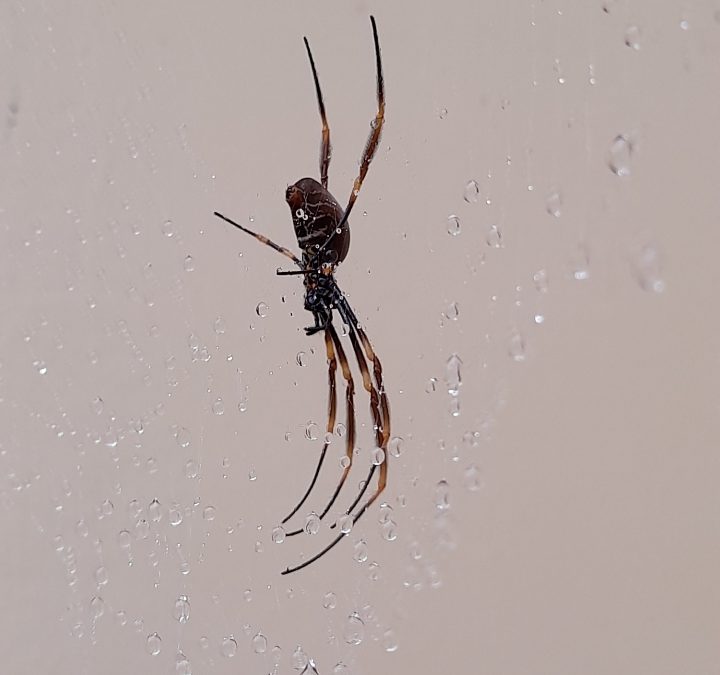
Glistening in tiny raindrops that resemble silver balls of dew, Arachne sits queen of her web, which has appeared overnight across my doorway. Usually i wouldn’t turn an outdoor light on before dawn, as i am comfortable in the darkness and keen to take in as much of the night sky as possible before Aurora shimmers silver across the horizon from the east. But i’m not at home. I’m staying in a rustic retreat centre in the Sunshine Coast hinterland, south east Queensland, leading an intensive for ecopsychotherapy students. There’s no sunshine, though. The rain of our Australian La Nina continues. Hopefully there’ll be no more flooding, although Mullumbimby residents are meeting again, in preparation for ‘Severe Weather’.  

The light goes on and i step out, carefully, mindful that each step is a moment in time, not rushing to see if there is any chance of glimpsing the sunrise through the clouds. And there she is; i see her just in time, so that the door doesn’t take out her web, she doesn’t feel panicked as her airy world is shaken apart, and doesn’t end up crawling across my face.

Because i was moving slowly, i don’t have to clear silky strands from my face and help her back into her broken web. Instead, i take the time to stop in awe of her beauty. I know i should go and help my co-facilitator set up the hall for our morning yoga session, but i can’t drag myself away from this stunningly beautiful vision. Tiny crystalline balls of water glisten in the electric light, across her body and web, which is a spiralling cage of death to smaller insects, but a geometric pattern of wonder to me. My door has broken one long strand, which connects the web to the ground, so when i finally walk away, she is working on repairs. 

There is no dawn glimmering today, so i can’t perform my Sunrise Ceremony, and the heavy cloud cover means no Venus, Jupiter, Mars or Saturn (or Aphrodite, Zeus, Ares and Kronos) either. I’ve been tracking this predawn planetary alignment for weeks, as i perform my morning prayers at home. It is good to be visited by the gods and goddesses, occasionally. 

Back inside for yoga just after dawn, then out on Country after breakfast. What do we find when we reconnect with nature? Participants speak lovingly of rediscovering childlike delight in little things, of the watercourses they visit when they are stressed and how much calmer they feel after some time there, or of a rock in a special place that recreates a feeling of stability and confidence that has been eroded by modern reality. We speak of encounters with butterflies and ducks, of when we sense a grander scheme of things, when facing the ocean or the sky, or how we get our breath back with a walk in the bush. 

We start with reality. Where are we at today? We probably shouldn’t have to work to find solace in nature, but we do. So, we create that space, sharpen our ears, make time and allow ourselves to sink back into connection. Many find deeper rest here, some feel more enlivened. All note the way their sense of separation from nature is dissolved, how they return to a feeling of being in relationship with the land, other animals, the elements. The rain has its magical rhythm, even for those who have been traumatised by the recent floods. Tears flow, wounds are reopened and healed over again, genuine smiles come easy … the earth sings and we tune in. 

We sit in the Temenos, the sacred and safe space where all sharing is valid, where our vulnerable, soft, sometimes broken animal selves can peep out and find comfort in others. We practise walking therapy, deep listening to each other as well as nature, not talking over or waiting to respond, but being there, offering authenticity and the ‘unconditional positive regard’ recommended by person-centred counselling godfather Carl Rogers. 

We choose Sit Spots, where we can become more aware of changes in the natural landscape from day to day, moment to moment. We open up the doors of perception and come back to our senses in the moment. We draw the mind back from its monkey-like grasping and from the machine that captures us all, all too often. Guided meditations draw our awareness down into the earth’s hum, into our unique being and our universal flow at the same time, into animal totems old and new. We learn from nature, like we always did. It provides endless metaphors of healing, empowerment and flow; the grass bounces back after being trodden down, a river flows around the rocks that seemed like barriers at first, a gentle breeze brings us back to our bodies in the here and now. 

We let nature tell our life story for once, and sing around the campfire, like people have always done. It is all so easy, smooth and natural, we wonder how we ever lost this feeling in the first place. 

*NB: boundless thanks to the participants and my co-facilitator Charlotte Brown. All photos by the author. If you feel moved by these words, please consider Subscribing, Sharing or Liking this post.

The Song of the Earth

The Song of the Earth

It was really refreshing to have a conversation with my mate, Dr Thomas Bristow, an expert in ecopoetics, and Senior Editor of the journal i am also an editor for, PAN: Philosophy Activism Nature. Tom wanted to chat about what the Romantic poets – Blake, Yeats, Wordsworth, Byron and co – saw in nature, and in particular what they learnt from listening for the spiritual aspects of the earth. It was a fun yarn and we touched on many aspects of the subject matter, following a handful of questions, or prompts, in a free range flow. Tom called this chat ‘Romantic Vision’ and you can access the video of it here (no pressure, but Tom tells me this may only be posted for a limited amount of time).

But first, i must wonder aloud about the value of literary explorations, poetic conversations, appreciating the Romantics and attuning ourselves to our local ecosystem in an age of planetary destruction. There’s a point in the interview where i admit that Thich Nhat Hanh might be right: perhaps what we most need to do is to hear the earth crying. This is not a very good sales pitch. And it’s probably only true to a certain extent: we are also a miraculous incarnation of consciousness in a primate body, embodying the spirit of life in a fantastically rich way, a celebration waiting to be had. My point is that opening our minds to the Deep Listening that i suggest at the culmination of this chat is not necessarily going to make you happier, but it may very well help you to be liberated from some of the more innocuous yet pervasive limits of your mind. Worth a shot?

To get there, Tom and i talked over the resurgence of European myth in the 18th century, which inspired Romantic poets to personify or anthropomorphise the environment, as a means to address ‘nature’, to represent vast fields of energy, beyond the human scale, and to create textual events that trigger legacies of ecocentric writing and orality. If you’re interested in the historical development of Western consciousness, you might enjoy our riff on how Romanticism worked as a response to Enlightenment. My key term for this was the ‘suprarational,’ which i saw as an attempt to develop consciousness beyond the human, to include our ancient predilection for pantheism, or notion that intelligence is a quality of the universe, or another dimension, which arises with this one (or even as its prerequisite).

This reminded me of the intelligence we find in nature, which is revealed in the way plants reach for the sun, or animals know instinctively how to hunt prey or follow seasons or find their way back across entire oceans to their birthplace. I can’t help but feel that for all of our technological development, the modernised psyche is a truncated version of something that could be far greater, in scope, depth and alacrity. We need to incorporate reason into our toolbox but be ready for so much more, when we open our minds to a conversation beyond the merely human, with plants and animals and places.

“We are leaning our for love and we will lean that way forever” Leonard Cohen

This more open-minded consciousness could also perceive more beauty in the world and thereby require less stuff from human society and production. There’s more to say about how recognising spirit of place can help protect the natural world, but i’m writing that for the next issue of PAN, so i’ll keep the water nymphs and satyrs for then.

When we are alive to the ecomythic dimension of life, human consciousness opens up to what actually is arising in nature, which is other forms of intelligence. This can also be called animism, which indigenous people have always said is real, not metaphorical: spirit beings, spirits of place, and spiritual entities are all other types of intelligent beings, which exist but do not take physical bodies in this dimension with us. They represent life force, sometimes of that place, sometimes from beyond. If we want to learn from them, we have to put aside our historical, socialised self, and enter into a trance of timelessness, beyond our personal foibles and concerns. Even as we are thoroughly enmeshed in capitalism and colonisation, simply by being alive in the world today, we can turn our backs on the worst of it, the most obvious effects it has on our minds, and find ourselves as we also always were and are: trailing clouds of glory, as Wordsworth wrote in his Ode on Intimations of Immortality.

Any true Romantic knows how to love a storm

Tom asked how we get there. I can only humbly suggest we meditate in sand dunes, or under trees, or by a babbling brook (or, if you’re in urban lockdown, on a pot plant and its own mysterious urge to live). A great place to start is with Miriam Rose Ungunmerr, who made the practice of Deep Listening more accessible to the public, especially helpful for non-Aboriginal Australians living on this ancient land.

Then maybe, if we can quieten the voices of our humanity for long enough, we might be able to hear the muses still, as they sing the song of the earth, for those who will listen.

*NB: Please Subscribe, Share, Comment … anything! It’s much more satisfying to write these posts when there is a conversation going on, believe me.*

Roadkill: A Symbol For Our Times

The dead wombat has been there for a couple of days now. The stench tells the story, as do the flies. The painted stripe down its back is another thing – a sign to those who care, that this one has been checked. Its pouch is empty; no babies need to be rescued from its dead body. Drive on, like everybody else does. We’re in a rush, or going too fast, or we’ve just seen it so often it doesn’t register anymore.

Roadkill – it’s an everyday reality for those who drive, especially long distances on country roads. It’s the collateral damage of the road trip. And it’s a sign of the times, a symbol of how we live, the things we can’t change, the fast pace of modern life and the way we treat the rest of the world (aka nature). We cut straight lines across the land, just as we do across the seas and skies, in order to get from one place to the next as fast as humanly possible.* Because we have business to do, people to meet, more immediate concerns than caring for the land and the planet that is our home. More important stuff.

That’s how we got here – to the precipice of the ecological emergency, which afflicts the entire earth now, the cliff over which we are hurtling since the feedback loops started to kick in. We burn greenhouse gases and turn the plants and animals into agribusiness and treat them all like grist to the mill. Any cereal grain or docile beast unfortunate enough to be domesticated has been ‘farmed’ – or more accurately, industrially exploited – to the point of complete depersonalisation.


You couldn’t do to battery hens, pigs, or feedlot cattle what is routinely done on behalf of obscene profits if you actually had to face what these animals feel.        We couldn’t decimate the insect population and pour countless trillions of litres of chemical run off, of pesticides and fertilisers, into the sea, creating desolate coastlines and Great Barren Reefs, if we cared about the rest of the earth’s population.


It’s all about the wheat, the rice, the cotton; not the birds, the bees, the native grasses or traditional remedies that used to grow here. Where? Anywhere.


This dead wombat is one of the dozens I see every week on my work commutes. Smashed to death by a metal bullet hurtling down the road at 100kmh, another human being at the wheel. Almost inevitably, we won’t stop to witness the passing of another life at the hands of modern society. It’s just what we do. Kill thoughtlessly, randomly, impersonally, as an inevitable side effect of our hustle and bustle. This is what we have done to our planet and home.


Roadkill is a symbol for our times.


  • For more on the mythology of straight lines, see the ecomythic doco “City Living, Nature Calling” here.