Whichever way you cut it, we’re in for darkening times. That much is assured. We need to start talking about this if we want to survive, for as long as we can, with any shred of dignity. And there is a challenge, raise the bar! We want to be going down fighting, but with the good fight in mind, the one where we take care of each other, compassionate beings knowing our destiny was always death beyond whatever we could achieve in this lifetime, not reacting harshly to this bottom line, remembering there were never any promises, holding out a helping hand whenever we can.
So I took part in this course, Leadership and Communication during Societal Breakdown, with Jem Bendell and Katie Carr. Jem has been writing the Scholars Warning letters since November 2020. They outline the risks of societal collapse and argue that we desperately need our so-called leaders to act on climate science. It’s like a gathering of educated adults acting like a heroic Swedish school kid, or something crazy like that. I’m proud to join hundreds of these wise souls from dozens of academic disciplines including climatology, environmental science, psychology and sociology.
Of course, i no longer believe we will effect meaningful change in time to avert disaster. That is no longer the point, for me and those others who know the data, the habits we are stuck in, the longer picture of civilizations collapsing one after the other into the desert sands. After 30 years of environmental activism, i accept our imminent demise and work to Save Our Souls instead. Send out the Morse Code, like climate scientists did at the Rio Earth Summit in 1992. Yes, 30 years ago now!
Jem also commented meaningfully on this anniversary here. His work to raise awareness of just how dire things have gotten is often called ‘doomism’, but critics miss the point – without facing reality squarely, we will never change. Like the Extinction Rebellion movement, he follows the psychological realisation that anticipating massive disruption and even the breakdown of industrial consumer societies helps inform those of us who are highly motivated for radical action. Welcome to Deep Adaptation at a glance!
Signatories of the Scholars Warning letters are now connecting with each other and exploring potential collaboration and future action, through the Leadership and Communication during Societal Breakdown Course. Alongside Jem’s expert knowledge about the ways conventional leadership is failing us in terms of facing possible collapse, facilitator Katie Carr holds the group in empathic listening and collective investigation of the question: what makes a good leader in the current historical context? Both Jem and Katie embody the leadership that is a strong contender for the answer to this question: it’s as good as we can approximate to a circular counsel, as focused on supporting each other as coming to any kind of necessary consensus. Along with others, i paid it forward, so if you want to pursue this course of action start here.
Dismayed as i am since those heady days when we seemed to still have hope – to turn the ship around, to convince world leaders and the public we actually had to, to become green and sustainable – i work mostly in the field of psychotherapy nowadays. At least we can hope to help people who turn to face the dangers now cascading across the horizon to breathe, to care for each other while we still can. But it isn’t enough to hold off the grief. The other night i slipped out behind the laundry to sob so that my children didn’t have to see the inconsolable fear and grief in my eyes. They don’t need to witness this yet; their futures will be impoverished enough, compared to the relatively benign, even beautiful decades i have enjoyed.
Entering the course i was convinced by the NTHE data and that hasn’t changed. So it was a great relief to recall how much meaningful work, alongside other people, brings you back around to life, to what is important. I know this from my work in the ecotherapy field, especially seeing the enormous benefit that community gardens have brought so many, both here and in the UK. But this went beneath my comfortable intellectual understanding, to bring me back into the fold. I’m most comfortable on my own or with nature – inner or cosmic, i can usually find happiness, or at least solace, in philosophy or dreaming. Other people – who even are they? Strangers, sometimes friends, aliens … my weakness.
Thankfully i find enough inner resources to reach out, on the odd occasion, and link up with some external ones. People shouldn’t be thought of as resources – neither should natural elements – but sometimes we need to find a shoulder to cry on, a hand to lift us up, someone else to help us to understand we might be backing ourselves into a corner.
It doesn’t matter what we think or pray the future holds. What matters is what we do with our time. If you are concerned about ecosystem and societal collapse, climate chaos and all the other disaster coming down the line, let me extol the virtues of doing something about it. Not as if we are going to find some miraculous way out of our catastrophic dilemma – but as if we could still find something in each other worth holding onto.
Bushfires in Australia and wildfires in the Pacific Northwest, and everywhere else they are raging out of control, take out plenty of prepper properties, as well as more conventional buildings (not to mention the millions of other lives). The recent floods in northern NSW, outrageous in their extent, must have washed out countless veggie patches, some of which would have been substantial. The days of thinking that individualistic, survivalist forms of prepping, to create climate proof shelter and food sources, are over.
I’m still growing as much food as i can, but now i know that could all be flooded out tomorrow. I’m still hunting in my local ecosystem for protein, but now i know those same floods make conditions for my chosen sport – spearfishing – completely hopeless. I see that my own humble efforts are part of a bigger picture of trying to become free from the mass markets and their supply chain weaknesses; and i see that none of us can become free of climate chaos.
.
We knew ecosystem collapse was going to be non-linear, but now the results are starting to become known. They are not completely random – superstorms will whip up more intensely in certain places, due to ocean currents and prevailing wind patterns, while droughts and heatwaves will become more prominent in some places than others. But regardless of the randomness or predictability of the effects, one thing we can be sure of is that we are about to be as psychologically assaulted as people have ever been. And this time the “we” really is everyone.
Sure, the 1% and other assorted squillionaires might hold out longer in their bunkers, enjoy whatever media they have pre-recorded and swill whatever goods they have shelved while we bake on the surface above. But eventually, apocalyptic conditions will affect all of us, everywhere, all the time, increasingly. All humans as well as most other animals and complex life forms are going to be as ‘baked in’ as the feedback loops that now ensure that climate action will no longer be enough to mitigate a mass extinction event.
Given that those exponential graphs still ain’t going nowhere but up and off the charts, i think it is time we got all post-doom and cranked up the volume on our spiritual response to this reality. And by spirit, i simply mean the essence of a thing, the enlivening force, the mysterious energy that explodes into life as the universe, and as consciousness, and incarnates as us sentient beings, intelligent primates, self aware and embodied by some miracle we did nothing to deserve.
In fact, celebrating this is half my answer. Getting back to thankfulness, appreciating our outrageous fortune, loving life in all its myriad forms while we still can. Recognising that all the work we do for our environment, all our attempts at evolving social justice, every act of compassion is a drop in the ocean of eternity – not producing anything, not changing the direction of the world, just doing good for its own sake.
Surrendering to this is humbling and beautiful. My Zen practice – a prosaic term for breathing in the miracle of presence in every moment – has never been so strong and lasting into the day as it has been since i gave up thinking i was going to change anything except the way someone thinks for a while, the way a child smiles when i am genuine with them, the way a bee flies on when i rescue it from tidal seawater, the way a plant flourishes because i watered it.
Aside from this deeply personal response, which all of us can make, immediately, and keep doing, there is community. That will be the subject of my next post; how we can work together, in groups of like-minded individuals, for mutual support. I’d like to be doing this more in my local area, but in the meantime i am currently facilitating retreats to help people connect more deeply with nature, for the purposes of therapy and liberation, and i recently enjoyed Jem Bendell and Katie Carr’s Leadership and Communication During Societal Breakdown course.
These are the most effective prepping activities we could be doing right now. Getting better at living again, for the moment, for the little things, while we can, together and alone. There’ll be plenty of big stuff to attend to, no matter where we live, soon enough. And in the meantime, children still smile when you are kind to them. Even adults do sometimes …
Please Like, Share and Subscribe if these words meant anything to you.
Let’s begin with the comment from the inaugural post in this new thread. If Teresita is right and most of us know deep inside that we are doomed in the near future, what do we get out of either facing this probability head on versus not thinking about it too much? As Teresita writes, “In a very human aspect we all want to live our lives … as if nothing was about to happen. Love needs to be circulating. The risk of depression and apathy is very high if we accept this truth just like that.”
So, let’s focus on attention and awareness. I want to face the truth of what is coming, so that i can live and die as consciously as possible. How to avoid sinking into depression, apathy, anxiety or fury, when we see that the human race is about to be culpable for the extermination of most life on earth, as the hothouse explodes into action over the next few years, if not decades? One way of thinking this through is to think in terms of investment and reward – a strikingly capitalist, or at least materialistic metaphor i know, considering we are talking here about values, psyche, heart and soul. But i’m going to try and stick to the here and now, the realities of our physical existence as much as possible, while we can. There will be time for the spiritual possibilities later.
Let’s roll the dice. Life’s a gamble, yes? We never quite know what the result of our actions will be. Let’s say we focus some attention on an imminent, planetary extinction event. What is the reward for this path? What is the reward, or possible set of outcomes, for avoiding this? Preparing the mind for chaos seems to me more valuable. What will we do when societal breakdown becomes one of the realities between now and then? When people are hungry, homeless, shocked, destitute, desperate? They will be looking for answers where there are none. The least we could do, as thoughtful people with the courage to look ahead, is to be ready with whatever little shreds of wisdom we can muster, like bits of flotsam on the flood.
I believe the horrors will be worse if we don’t prepare our minds, our hearts and souls for what seems inevitable. I want to live and die like a beautiful social primate, capable of self-awareness and generosity of spirit. We are all going to be challenged more than we can yet even possibly imagine. A bit of preparation can go a long way.
*NB: I’m going to try to keep these meditations short. Please Like, Share and Subscribe. Please leave comments, suggestions for the dilemmas we need to discuss, questions, debates, interventions etc.
Image: La Bête de la Mer (Tapisserie de l’Apocalypse) / The Beast of the Sea (Tapestry of the Apocalypse)
The second of my two very vivid childhood dreams reveals why I am not crushed by the other one, where our world crumbles away beneath our feet. While that dream foretold the extinction event we are currently experiencing, this one reminds me that no matter how much terror, anxiety, depression or grief we experience, there is wisdom in the shadows.
In this dream, i am a boy, wearing a classical toga and leather sandals. I run across the desert sands to an enormous dome building. I am very comfortable here and climb some stairs, which wrap around the dome to a flat concourse. There is simple, unreflective joy in my heart – the kind we experience so easily as children and so rarely as adults.
Suddenly, something moves in a shadow to my left. I look back, jolted by a ripple of fear in response to this movement. Out of the shadow of a stairwell an old man appears. We stare at each other for a moment, while I am frozen to the spot, wondering what will happen next, still a little scared. He smiles. There is warmth in his eyes, knowing emanates from his visage; he is comfortable in the world and wants me to feel the same.
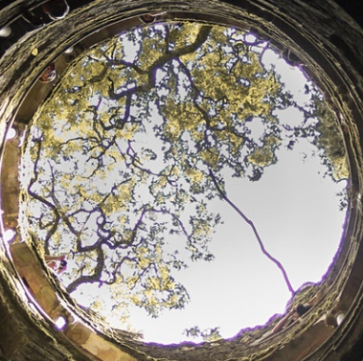
At his smile, my childish innocence and faith in life instantly reappear. I turn back to run along the rampart. As i do, i look more closely into the clay bricks of the domed wall. There i see tiny capillaries in the wall, which i had never noticed before.
The renewed depth i discover in my vision, as a result of this apparition, works to balance the joyful innocence of the boy. Importantly, out of the shadows appears not threat, but comfort; the wise old man of archetypal power contains a frisson of danger, as true gnosis (or inner knowing) always has. But with his smile I do not fall into fear, but into an edge of discovering the unknown instead; it is the mystery that lasts and draws me along.
The Old Man expresses that wisdom or spark in us that is beyond the comforts of everyday life, what we have become used to, the personality we identify with. He is not an emissary of conventional religion, like the priests who promise hope for our lives after death if we obey their holy writ. He obeys only the imperative that is crystallised in the image: the archetypal Old Man brings wisdom from the realms beyond what we are thus far aware of; that is the whole point. Jung became wise enough through his contact with the archetypes to know they bring together a wide range of possibilities.
Coming out of the darkness, he brings wisdom – and we never needed it more than now, as we face the catastrophic, combined realities of anthropogenic climate change, ecosystem breakdown, increasing political instability and the widespread extinction event that has already begun. However, it would be facile to claim that out of the darkness (of what is happening to our planet right now) a light will come. I write of my dream now not to promise a new dawn, or comfort us with any other simplistic metaphor designed to avoid taking responsibility for the ecocide our species is responsible for. Empty hope and cheap consolation do not honour the untold suffering that will be visited upon humanity as we begin to discover what crop failures, superstorms, megafires and freakish flood events really feel like. The extinction of so many of our animal cousins and plant kin alike deserves more. It deserves awareness.
We can develop deeper awareness by looking into the Shadow, seeking the wisdom that arises from our place of not knowing. This is how the Mystery Schools found faith in gnosis for over 2,000 years. Yet, while we explore our own inner realms and Wizened Old figures, staring into the darkness without guidance can lead to despair. For as Nietzsche so presciently wrote, when we stare into the abyss, it stares back into us. What do I find when I look into the shadow, of myself and of my race? Something tells me that, if I look deeply enough, I will find not only what I fear, but what grants me greater insight, too – and perhaps even an element of solace.
I have written before about how we can find this, even when we realise that we are enmeshed in, and therefore part of, the system that is destroying the earth. With the dream of the Old Man, I recall that there is wisdom beyond courage; beyond environmental activism, beyond righteous indignation at the failure of our leaders, beyond the sad but inevitable realisation that the world as we know it is now collapsing beneath our feet.
The Old Man does not forgive the evils of transnational corporate greed, which have ensured our downfall; nor does he forget the corrupt media that sells the stories of the military industrial complex. But neither does the archetypal Old Man want to beat us up with guilt, since we have failed to stop the madness and destruction. He understands that the evolution of technology, the politics of power, the fact that we were born into this damnable system without willing it, the way we were sold the modern mythology of work, profit, holidays, breeding up and finally retiring to play Scrabble or bowls … all of this is beyond our power to change, except to the extent that we can make better choices.
The better choice we could make right now is to transfer our values from the damaging system of capitalist profiteering to the timeless tales of power, wisdom, grace that remain available to us in our dreams, our myths, our symptoms and even in our nightmares. The Mystery School lives on, because it is a representation of the ancient wisdom coursing through our veins and dancing in our DNA right now.
There is no future – the kids doing tang ping have figured it out – but there never really was. What is left to us now, beyond apathy and resignation, is deepening of the soul, refining of the spirit, transformation of the self. Nothing good will come of our planetary death throes and no amount of hand wringing, sobbing or admission of guilt will alleviate this awful reality. Rather, i will recall the wisdom of that old man and consider the life of the butterfly as my guiding metaphor. We crawl away to create a cocoon, withdraw within it, and dissolve into goop. These old selves must die.
Every traditional culture teaches that part of us passes over to another realm. With an ear on that wisdom, i have faith that my soul will crystallize into a new lifeform, in a new dimension, where i will find the strength to grow, until i am ready to break out and fly free, on another adventure. One day i will be that old man, looking out from the shadows, unexpectedly frightening the children i meant to comfort, while helping them to see that looking into the depths will deepen their vision, their insight, their capacity to look more clearly into who they are and what their relationship to the earth is.
*Thank you for reading my Nature Calling blog. If you got something out of these words, pleaseShare, Like and Subscribe to the blog (upper right corner). It really does help to keep the juices flowing.*
Images: Featured Photo by Ivana Cajina on Unsplash;; clay Photo by Wesley Tingey on Unsplash; Painting of a sea monster by Carl Jung, from his Red Book; painting of a fire serpent by Carl Jung, from his Red Book.
One of the two very vivid dreams I recall from my early childhood in the 70s was a warning about the current times. I think of it sometimes, as it informs me about how to steady myself for the extinction event that is currently escalating on our planetary home.
Although very young when I dreamt this, I am a bearded man in the dream, standing on a granite pavement, with my two children standing innocently next to me. It feels very Atlantean; we are part of an advanced civilization, proud of our place in the world. I had been in some kind of committee meeting, inside a marble hall, and had come out for some fresh air and to see my children. Suddenly, without warning, the ground began to rumble beneath our feet. In no time at all, the pavement was crumbling away, and I begin to lose my footing, which seemed so secure just moments before. I instinctively reached down, grabbed both of my children in my arms, and pulled them up to my chest. It felt good to have them so close, even as the world collapsed into an abyss beneath our feet.
And that’s it. Like so many dreams, it simply ends, having appeared to my young mind from … from where? Nothing in my early childhood offers a reliable compass for this vision. It is a spontaneous irruption from the collective unconscious, a pattern of longing, shock and adaptation, an archetype of life and death arising out of the storehouse of human myth and symbol.
But the imagery says so much – and its visionary power goes a long way to explaining why I have always known that the world as we know it would end in my lifetime. Now that we are seeing evidence of this everywhere, it is time to draw upon the endlessly fascinating world of myth to try and navigate the tumultuous seas that are crashing down upon us, as runaway climate disaster is matched by unstoppable ecosystem breakdown, all in feedback loops of their own.
So, what can the great stories from the collective annals of culture tell us about where we’re at now and what we can do about it? What wisdom can be imparted by studying the ancient ways, as well as waking up to the limitless miracle of the moment (which is really where myth points, endlessly).
The end of this world has been a consistent image in world mythologies, from Biblical revelations to Mayan calendars, from nuclear threats to Kali Yuga. There is little point in running over the false starts and fake prophets that have predicted that The End is Nigh! So, just as my MA tracked the way that our dreams link us to the mysterious worlds of myth, let’s return to its life changing power and see what can be further divined from it.
I mention that my dream felt Atlantean, knowing that the original inspiration behind the myth of a lost but highly advanced civilisation can be found in Plato’s dialogues Timaeus and Critias. In the latter, Plato tells of the fast and furious fall of the legendary Atlantis, when “there occurred violent earthquakes and floods; and in a single day and night of misfortune … the island disappeared in the depths of the sea.”
An entire civilisation disappearing in 24 hours is a classic ‘warp’ of mythic time, which is often elastic enough to stretch out towards the infinite (which we can experience when we practice timelessness) and back in towards the intimate (which is how we experience time in an embodied sense). Plato’s 24 hours can remind us of the riddle Oedipus answers to destroy the Sphinx at the gates of Thebes, unwittingly ensuring his own downfall: what creature has four legs in the morning, two during the day, and three at night? A human, whose life passes so quickly from the face of the earth that it may as well be one day – from crawling infant, to free standing adult, to the elder holding themselves up with a crutch – our entire lives pass as quickly as a mote in time.
This also makes sense in another way: the entirety of large-scale human civilisation – urban settlements built on the profits of agriculture and colonisation, magnified a hundred-fold with the industrial revolution – has risen and will fall in the blink of a geological eye. Our moment in the sun has been brilliant and short-lived. Like Atlantis – both the one Plato claimed was already an ancient myth in his day and the imaginative one that has been dreamt up many times since – we are now crumbling into the sea. And as in my dream, it is now happening very, very quickly. Technological development and ecosystem destruction have been increasingly rapid in postmodern industrial culture. But as I never tire of pointing out, the exponential pace of this machine was set in motion during the agricultural revolution, thousands of years ago, when we changed from treating the life around us as kin and instead started to think about it as a set of resources for our use.
And now, we are visiting panic time. Mental health issues are skyrocketing – a pandemic is highlighting and magnifying this, because we mammals don’t flourish when we are socially isolated – but we can expect this to continuously escalate, as the true horror of what faces us next becomes increasingly apparent. We don’t need old time prophetic predictions anymore – a hot house earth is now a matter of scientific certainty and will spell the end of the world as we know it (certainly for the beer and skittles reality we in the affluent west have enjoyed over recent decades).
The only thing left to do is to prepare for the best possible end we can, to draw near those or that which we love, resist the urge to become frantic, let go of our sense of entitlement, practice meditation and breath work and become proficient in dealing with grief. (I’ll keep practising environmental activism, btw, but the days are gone when we might have dreamt we were going to make any real difference to the near future of the planet.)
It’s time to spend the rest of our lives building relationship with the sliver of our consciousness that remains connected to the eternal spark of life. Paradoxically, the practice of seeking to awaken to the timeless can deepen our awareness of the moment, as we experience life in the body, in the here and now, this unrepeatable but soon to pass opportunity to be exactly who we are. Breathing in connection with all that is connects us to the spirit of life that emerges out of the universe and falls back into the ultimate matrix upon its death. Like everything else, we are the flourish of a brush stroke, the coming into being of a certain kind of energy, the passing of a firefly in the night.
My childhood dream is like a lifetime’s memento mori, a reminder that death awaits us all. My guiding metaphor for the awakening I seek out of it is the life cycle of the butterfly. We have been crawling along as caterpillars, but now it is time to create a cocoon, withdraw into it, and dissolve into goop. These old selves must die. This applies on multiple layers and across differing contexts of our lives; I recently emerged from a 5-year apprenticeship to nature spirit, guided again by my dreams, this time to leave the city and live a coastal life far away from my academic and other urban pursuits. This whole period of life, including work and parenting and being in the world in my way, was like a cocoon compared to my previous existence. But I also feel like every night is another cocoon, out of which we emerge renewed; as is every meditation sit, every relationship breakdown, every opportunity for change.
No matter what the context, we can see in nature that there is a basis for trusting that the goop of our dissolved self will re-crystallise, that a new being will grow and build strength, that eventually, after a long, dark night of the soul, we will break out of one cocoon and fly free to another dimension of ourselves. This is the cycle of energy that gives rise to religions: all that lives must die and out of death comes new life. Quantum physics tells us the same thing – life is energy and it is never completely snuffed out, just transformed. To believe that this is what happens to us, to our bodies and consciousness, when we die makes just as much sense as any other faith, like the one that states that consciousness arises out of physical matter and life is ultimately meaningless. As the world crumbles away around us, which myth will you choose? To hold onto the last vestiges of your sense of entitlement; to party as much as possible; to forgive and expand; to prepare for another dimension?
Every traditional culture teaches that part of us passes over to another realm. With an ear out for that wisdom, we can live for the moment and experience the vibration of a living, intelligent cosmos. If we do so while practicing compassion for the suffering of all beings, we may even realise some small measure of liberation from the confines of the self along the way. The possibility of spiritual liberation in itself should be enough to inspire us to reconnect with the ocean of eternity, beyond the iron cage of reason and the isolation of the individual.
I’ll still reach for my kids as the world crumbles beneath our feet. And I’ll still be thankful to feel their breath on my chest as we fall into the abyss below. That’s because the shadow of death does not seem a threat to me, but a promise. This is the ecomythic in action – inspiring compassion for all creatures, celebrating a living cosmos and an animate earth, within which we all dance, for that limited time we have allotted.
*NB: if you got something out of this post, please Like, Share and Subscribe. It really does help me to keep writing.